Be part of the solution. Support WWF today
Posted by johnmalloy333(at)gmail.com | Tuesday, November 20, 2007

Infrastructure 'near collapse'


OTTAWA - The infrastructure in Canadian cities is "near collapse" and will cost $123 billion to repair and replace — money that municipalities don't have, a new report warns.

That figure is far higher than previous estimates and indicates that the physical foundations of cities like Toronto are deteriorating faster than first thought, municipal officials said today.

"If serious action isn't taken now, our infrastructure is headed for collapse — the problem will simply overtake us," said Gord Steeves, president of the Federation of Canadian Municipalities.

The municipal association today released a new study that shows that the cost of repairing aging bridges, roads and water systems has soared in recent years.

And it called on the federal government to create a "long-term national effort" to eliminate the so-called infrastructure deficit, warning that towns and cities lack the financial resources to pay for the repairs themselves.

Steeves, a Winnipeg councillor, said he has written Prime Minister Stephen Harper and the three opposition leaders, urging them to acknowledge that Canada is the "tipping point.

"Coordinated national action and political will is necessary — today," Steeves told a Parliament Hill news conference this morning...

Posted by johnmalloy333(at)gmail.com | Sunday, November 18, 2007

What is Canada For?

Intent for a Nation: What is Canada for?

by Michael ByersDr. Michael Byers holds the Canada Research Chair in Global Politics and International Law at the University of British Columbia, where he focuses on the role of international organizations, the use of military force, the law of the sea, human rights and Canada–United States relations. Prior to July 2004, he was a Professor of Law and Director of Canadian Studies at Duke University in North Carolina.

His most recent book is Intent for a Nation: What is Canada for?, a title inspired by conservative philosopher George Grant’s influential 1965 work, Lament for a Nation, in which Grant grimly predicted the inevitable absorption of Canada by the United States.

Byers sat down with Adbusters Contributing Editor Deborah Campbell recently to discuss the past, present and future of Canada on the global stage – including how long those Canucks have before the Yanks swallow them alive.

On George Grant’s fatalism

This thesis that Canada was destined to lose independence due to very powerful forces, such as economics and global culture, that was part of the accepted thinking through the 1980s and 1990s. We were all going to become this sort of bland, same-thinking, Hollywood-oriented, global community. For Canadians, that made it so much easier to go along with the requests and pressures that were emanating from the us.

But Grant made a fundamental analytic mistake, which is that he assumed that economics is everything. He also assumed that cultures are relatively malleable, not deep-rooted. Those two assumptions, I think, are both wrong, they’ve been proven wrong. On the economics front, 86 percent of Canada’s trade was with the US when Canada said no to the Iraq War. That was a really big ask from George W. Bush at a time when he was phenomenally powerful. And yet, we were able to say no. That flatly contradicts Grant’s thesis.

On the cultural front, as we know from social science work like the World Values Survey and some of the work done by people like Michael Adams, Canadians and Americans are actually diverging. This has to do with the fact that not just Canada, but also the US changes. We have institutions that feed into our values, so the existence of universal public health care isn’t just an expression of our values – it in turns feeds back into how Canadians think about community.

Grant’s thesis seemed to be playing out through the ‘80s and ‘90s, partly because of Brian Mulroney’s overt pro-Americanism, the negotiation of the FTA in 1988, and then NAFTA in 1994, but also the effects of the relatively benign, charismatic Clinton administration’s approach to North American affairs. Then along comes George W. Bush, along comes 9/11, along comes the disaster of the Iraq War, the foolishness of the American torture policy, the rise of the religious right – a whole bunch of things that a lot of people wouldn’t or couldn’t have anticipated – and all of a sudden Americans are on average moving away from us faster than we would have been moving towards them...


Posted by johnmalloy333(at)gmail.com | Tuesday, November 13, 2007


Click to Enlarge


sent to the network by Jim Kinnear...

Posted by johnmalloy333(at)gmail.com | Thursday, November 08, 2007


Study finds that veterans constitute

a quarter of America’s homeless


Study finds that veterans constitute a quarter of America’s homeless
WASHINGTON - Veterans make up one in four homeless people in the United States, though they are only 11 percent of the general adult population, according to a report to be released Thursday.

And homelessness is not just a problem among middle-age and elderly veterans. Younger veterans from Iraq and Afghanistan are trickling into shelters and soup kitchens seeking services, treatment or help with finding a job.

The Veterans Affairs Department has identified 1,500 homeless veterans from the current wars and says 400 of them have participated in its programs specifically targeting homelessness...

Posted by johnmalloy333(at)gmail.com | Monday, November 05, 2007


Unchained Memories: Readings from the Slave Narratives

In the late 1930s, an estimated 100,000 former slaves were still alive in the United States. In the midst of the Great Depression, from 1936 to 1938, more than 2,000 interviews with one-time slaves were conducted for the Work Projects Administration (WPA) via its Federal Writers' Project, with the transcripts (written in the vernacular of the time) forming a unique firsthand record of slave life. Unchained Memories: Readings from the Slave Narratives presents dramatic selections from the extensive Slave Narrative Collection through on-camera readings by over a dozen actors, interspersed with archival photographs, music, film and period images. This 74-minute HBO documentary brings the selected words of these former slaves to life through the voices of celebrated African-American actors - Narrated by Whoopi Goldberg, the film features emotion-charged readings by Angela Bassett, Michael Boatman, Roscoe Lee Browne, Don Cheadle, Sandra Daley, Ossie Davis, Ruby Dee, Robert Guillaume, Jasmine Guy, Samuel L. Jackson, CCH Pounder, LaTanya Richardson, Ruben Santiago-Hudson, Roger Guenveur Smith, Courtney B. Vance, Vanessa L. Williams, Oprah Winfrey and Alfre Woodard. In addition to their in-character readings, the actors sometimes add their own anecdotes and editorial comments..

Posted by johnmalloy333(at)gmail.com | Monday, November 05, 2007


Six Steps to "GETTING" the Global Crisis

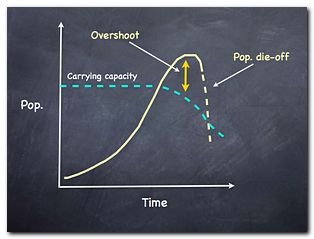
Overshoot

This is a guest post by John Feeney, Ph.D. Trained as a psychologist, John is today an environmental writer and activist in Boulder, Colorado. He began investigating environmental issues while fighting destructive residential development in a small Iowa town where he and his family lived for two years. His research pointed inevitably to the interacting roles played by population growth, the drive for economic growth, and our reliance on fossil energy in fueling the ecological crisis we now face. His website is called Growth Is Madness.

Some of us who examine and discuss environmental matters are constantly puzzled and frustrated by the seeming inability of elected officials, environmental organizations, and environmental and political writers to “get” the nature of our ecological plight. Could it be they’re simply unaware of the ecological principles which enable one to understand it?

Since some undoubtedly are getting it, and in light of the warnings in the UN’s latest report on the state of the global environment, below is a brief list of axioms and observations from population ecology with which everyone should be familiar. Most are taught in introductory level ecology and environmental science classes. They appear sequentially, so the reader can step logically through a progression which should make clear the nub of the global ecological challenge before us...

  1. A finite earth can support only a limited number of humans. There is therefore a global “carrying capacity” for humans. A basic definition of carrying capacity is “The maximum number of people, or individuals of a particular species, that a given part of the environment can maintain indefinitely.”
  2. It is an axiom of ecological science that a population which has grown larger than the carrying capacity of its environment (e.g., the global ecosystem) degrades its environment. It uses resources faster than they are regenerated by that environment, and produces waste faster than the environment can absorb it without being degraded. Some definitions of carrying capacity include this element of environmental degradation. Such a population is said to be in “overshoot.”
  3. Al Bartlett sometimes writes, “A SELF-EVIDENT TRUTH: If any fraction of the observed global warming can be attributed to the activities of humans, then this constitutes positive proof that the human population, living as we do, has exceeded the carrying capacity of the Earth.” The same can be said of much of the rest of the extensive and growing human-caused ecological degradation we see today, including the breakdown of the web of life indicated by the ongoing Sixth Extinction. It is symptomatic of having exceeded the earth’s capacity to sustain our current numbers for the long term. It is, in fact, proof that under current conditions we have done so. [1] [2]
  4. It’s axiomatic, as well, that a population can only temporarily overshoot carrying capacity. It will subsequently decline in number, to return to a level at or below carrying capacity. That is, though a population may grow in size until it is too large for existing resources to sustain it, it must subsequently decline.
  5. Because it degrades it’s environment, a population in overshoot erodes existing carrying capacity so that fewer members of that species will be supported by that habitat in the future.
  6. Our extraction of nonrenewable resources such as oil and coal has allowed us temporarily to exceed the earth’s carrying capacity for our species. As these supplies are drawn down, our numbers continue to increase, and ecological degradation progresses, the number of humans will, of necessity, come down. Whether we have a hand in voluntarily and humanely bringing them down, or simply let nature manage the whole thing for us, is up to us.

Posted by johnmalloy333(at)gmail.com | Monday, November 05, 2007

Adil Najam

As I wrote yesterday, the emergency declared by Gen. Musharraf is deeply disturbing, but not really surprising. The horrendous political situation that Gen. Musharraf described in his ‘Emergency’ speech is, in fact, true.

Extremism and violence has gone out of hand. Society is deeply divided. Religion has been high-jacked and is now routinely used to incite violence. The writ of the government is being trampled. Politicians have failed and people do seek recourse in the judiciary. People are frustrated and deeply disturbed. We have been writing and discussing all of this and more on this blog repeatedly. We cannot, therefore, deny what is obvious.

However, none of this is a justification for a suspension of the Constitution and for the declaration of emergency. In fact, all this is damning evidence of government failure. A suspension of the constitution will not and cannot resolve any of these issues. It is more likely to - and has already - made each of these situations even worse.

Posted by johnmalloy333(at)gmail.com | Monday, November 05, 2007

HEALTH EFFECTS: Fluoride & the Brain

Key Findings - Fluoride & the Brain:

1) Fluoride's ability to damage the brain represents one of the most active areas of research on fluoride toxicity today.

2) The research on fluoride and the brain has been fueled by recent human studies from China finding elevated levels of fluoride exposure to be associated with reduced cognitive ability (e.g. reduced I.Q.) in children.

3) The impact of fluoride on children's IQ has been documented even after controlling for children's lead exposure, iodine exposure, parental education and income status, and other known factors that might impact the results (Xiang 2003 a,b).

4) A recent UNICEF-sponsored study reported that in areas of China with endemic iodine deficiency, fluoride exposure during childhood significantly exacerbated the neurological deficits produded by iodine deficiency.

5) The findings of neurological effects in fluoride-exposed humans is consistent with, and strengthened by, recent findings from over 30 animal studies published since 1992. As with the studies on humans, the studies on animals have reported an impairment in learning and memory prorcesses among the fluoride-treated groups.

6) The animal studies have also documented considerable evidence of direct toxic effects of fluoride on brain tissue, even at levels as low as 1 ppm fluoride in water (Varner 1998). These effects include:

-- reduction in nicotinic acetylcholine receptors;
-- reduction in lipid content;
-- impaired anti-oxidant defense systems;
-- damage to the hippocampus;
-- damage to the purkinje cells;
-- increased uptake of aluminum;
-- formation of beta-amyloid plaques (the classic brain abnormality in Alzheimer's disease);
-- exacerbation of lesions induced by iodine deficiency; and
-- accumulation of fluoride in the pineal gland.

Posted by johnmalloy333(at)gmail.com | Monday, November 05, 2007

Sinking Currency, Sinking Country


The British pound is back up over $2, the highest level since the Carter era. The Canadian dollar, which used to be worth 65 cents, is worth more than the U.S. dollar for the first time in half a century.

Oil is over $90 a barrel. Gold, down to $260 an ounce not so long ago, has hit $800.

Have gold, silver, oil, the euro, the pound and the Canadian dollar all suddenly soared in value in just a few years?

Nope. The dollar has plummeted in value, more so in Bush's term than during any comparable period of U.S. history. Indeed, Bush is presiding over a worldwide abandonment of the American dollar. Is it all Bush's fault? Nope.

The dollar is plunging because America has been living beyond her means, borrowing $2 billion a day from foreign nations to maintain her standard of living and to sustain the American Imperium.

The prime suspect in the death of the dollar is the massive trade deficits America has run up, some $5 trillion in total since the passage of NAFTA and the creation of the World Trade Organization in 1994.

In 2006, that U.S. trade deficit hit $764 billion. The current account deficit, which includes the trade deficit, plus the net outflow of interest, dividends, capital gains and foreign aid, hit $857 billion, 6.5 percent of GDP. As some of us have been writing for years, such deficits are unsustainable and must lead to a decline of the dollar.

A sinking dollar means a poorer nation, and a sinking currency has historically been the mark of a sinking country. And a superpower with a sinking currency is a contradiction in terms.

Posted by johnmalloy333(at)gmail.com | Monday, November 05, 2007

Shocking: 18 Years on and

Exxon Still Won't Pay $2.5 Billion for Valdez Oil Spill

The Supreme Court's recent decision to hear ExxonMobil's reasons to void the $2.5 billion punitive award in the Exxon Valdez case hit the town of Cordova, Alaska, hard. This small coastal fishing community -- my hometown -- along with the Alaska Native villages in Prince William Sound have borne the brunt of the largest crude oil spill in America's waters; a spill that took place more than 18 years ago, but one that continues to hold the region hostage.

The second painful blow was the high court's decision to not even hear our reasons why the award should be restored to the full $5 billion that a jury of peers decided was necessary to punish the corporate giant back in 1994.

While media pundits, lawyers, and scholars play the Supreme Court's decisions back and forth like a ping-pong ball, people in Cordova share a completely different perspective of this story. It's not about whether the Supreme Court should hear the case. To us, it's about justice and reparation -- making us whole, a promise Exxon made to the community five days after the spill. A promise that Exxon broke before the trial even started five years after the spill...

Posted by johnmalloy333(at)gmail.com | Monday, November 05, 2007


Chris and Maciek "The Polish Connection"

in Meaford, Ontario, Canada


Posted by johnmalloy333(at)gmail.com | Sunday, November 04, 2007

Virtual Addiction

If you turn on your television set and look away at a nearby wall, you will discover that the reflections produced by the light from the TV vary constantly in contrast and intensity. It occurs to me that every cell in our bodies has been programmed to respond to light – when a shadow passes over a field mouse, it becomes alert to a potential threat. Abrupt changes in the intensity of light are indications of danger that our neurological system has evolved to respond to. What effects can a lifetime of exposure to this assault produce? It’s obvious that the intensity of visual and audio contrast in our lives has increased through the years. I assume that our brains’ response is a protective deadening of our neural receptors.

I am convinced that the passivity of the American public is related to this phenomenon. It is hard to believe, but a poll taken this summer indicated that two thirds of the American public could not name even one of the Democrats then running for president; meanwhile, three times as many Americans believe in Satan than in evolution. We have lost our sense of what is real and replaced it with an addiction to the virtual reality created by television, entertainment and advertising. The constant juxtaposition of images like that of a woman crying over a child lost in a fire and a commercial for Pampers amplifies this sense of meaninglessness and stupor.

One can make the case that we have lost the capacity for abstract thought. When we read, or listen to the radio, the mind forms images in response. The same can be said to occur when an illustration provokes the viewer to consider its symbolic relationship to reality. Abstraction encourages the mind to bridge the distance from suggestion to reality. There are certain tribes in Africa that do not distinguish between dream life and daily life. We find ourselves in a similar condition, but our virtual reality fails to serve our deepest needs.

In our world, reality has been replaced by forms of entertainment that require little mental activity and encourage inertia and apathy. How else can we explain the incredible indifference to their own lives and interests that characterizes the American people at this time? The misrepresentations of government, the outrageous dishonesty of business, the attacks on our civil rights, the collapse of our educational system and the failures of our social safety nets have produced almost no response or indignation from the American public. When Bush orders an aircraft carrier moved at a cost of $1 million so he can land on the deck without San Diego being visible in the background, he is aware that this manipulative misrepresentation will not affect his popularity, even after it is disclosed. I am certain, as it becomes increasingly obvious that we were deliberately lied to in order to justify a war with Iraq, there will be no general sense of betrayal. We no longer understand the relationship between cause and effect...

Posted by johnmalloy333(at)gmail.com | Sunday, November 04, 2007

China: Take Concrete Action on Burma Now

The Chinese government should immediately take concrete steps to help end state repression in Burma, Human Rights Watch said today in a letter to President Hu Jintao. China is one of Burma’s largest investors and suppliers of weaponry.
" Chinese officials have publicly called for ‘cooperation’ and ‘dialogue’ between the Burmese generals and their critics, but said nothing when these critics were arrested, ‘disappeared’ or killed. Even worse, the Chinese government has blocked


Letter to President Hu Jintao on Burma
Letter, October 17, 2007

“Chinese officials have publicly called for ‘cooperation’ and ‘dialogue’ between the Burmese generals and their critics, but said nothing when these critics were arrested, ‘disappeared’ or killed,” said Sophie Richardson, Asia advocacy director of Human Rights Watch. “Even worse, the Chinese government has blocked most of the international efforts to effectively address the crisis.”

Human Rights Watch noted that August 8, 2008 will not only be the opening date of the Beijing Olympics, but will also mark the 20th anniversary of the 1988 pro-democracy protests in Burma, during which an estimated 3,000 people were killed. Although the Chinese government chose 08/08/08 for symbolic reasons, recent events in Burma, and China’s ties to the military government, mean that the spotlight on that date will also be on the continued suffering of the Burmese people...

Posted by johnmalloy333(at)gmail.com | Saturday, November 03, 2007


"BIG" BOOST Audie Leenaars...

Owner of the Depot Deli and Pub in Grimsby, presents a $1000 cheque to Larry Lupis president of Big Brothers and Big Sisters Grimsby chapter. Leenaars and wife Lynn Clancy Leenaars donated the money with the help of customer donations.